News

Europe’s Push for Payment Sovereignty
March 31, 2026
Life Beyond the Traditional Payments Ecosystem
The global payments ecosystem has been dominated by a handful of international players such as Visa, Mastercard, PayPal, American Express and JCB. This dominance has prompted an important strategic question in Europe: should the continent continue to rely so heavily on payment networks that are largely managed and controlled beyond its borders? For a growing number of policymakers, central banks, and financial institutions, the current level of dependence is no longer acceptable.
The Dependence Issue
According to the European Central Bank, international schemes account for approximately 60% of European card payments, highlighting the level of dependency on these largely American networks. This reliance is increasingly being viewed as both a strategic and geopolitical risk. European leaders have raised concerns that critical financial infrastructure, including payment processing and transaction data, is largely controlled beyond Europe’s borders. Christine Lagarde, President of the ECB, has warned that Europe urgently needs its own digital payment solutions, noting that many European card and mobile payments currently run on infrastructure controlled by foreign providers.
Europe’s Challengers
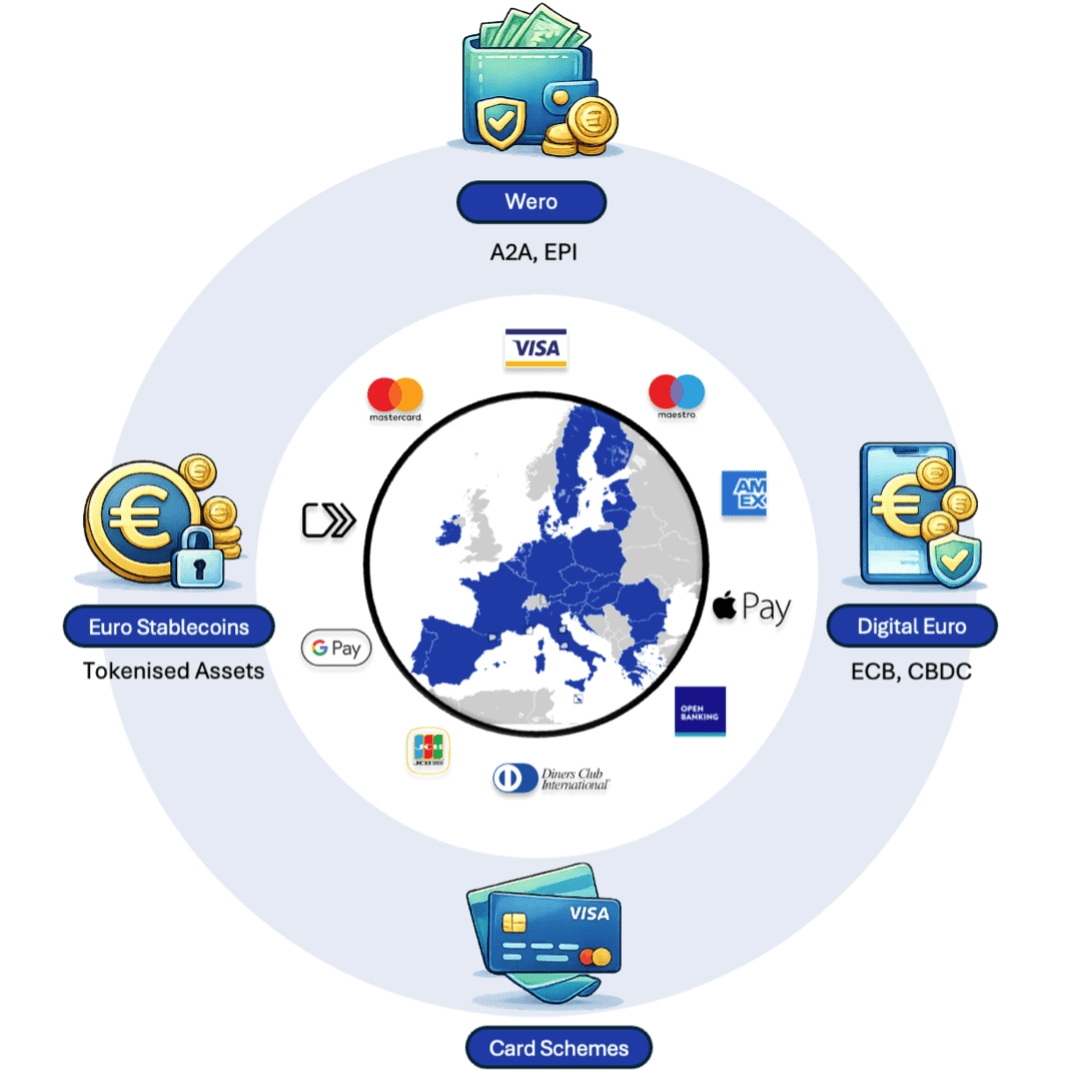
One of the most significant developments in this space is Wero, a pan-European digital wallet developed by the European Payments Initiative (EPI) and backed by major European banks. Launched in 2024, Wero aims to create a unified European payment solution capable of competing with global traditional card schemes. Unlike traditional card payments, Wero is built around account-to-account payments using SEPA Instant, enabling realtime transfers directly between bank accounts. The project is gaining traction. In its first year alone, Wero reportedly reached over 43 million registered users and processed more than €7.5 billion in transfers.
The Digital Euro
Alongside private sector initiatives such as Wero, the European Central Bank is also exploring the creation of a digital euro, a potential central bank digital currency (CBDC) The digital euro would provide a public digital payment infrastructure, allowing users to hold and spend digital euros through wallets issued by regulated financial institutions. Supporters argue that a digital euro could strengthen Europe’s financial sovereignty and provide a publicly backed alternative to private payment networks. However, the initiative remains controversial. Banks have raised concerns about its complexity, cost and potential impact on commercial bank deposits.
The Emerging Role of Stablecoins
Another development quietly entering the conversation is the emergence of euro-denominated stablecoins. Several European banks and fintech consortiums are exploring tokenised euros backed by fiat reserves, which could enable programmable payments, instant settlement and new forms of digital commerce. Unlike CBDCs, stablecoins are typically issued by private institutions but backed by regulated assets. They may provide a bridge between traditional finance and blockchain based payment networks, allowing European payment systems to evolve alongside emerging digital asset infrastructure.
Payments Industry Impact
Europe’s push for payment independence is not about replacing Visa or Mastercard overnight. Instead, it reflects a broader shift in thinking around payment sovereignty. Countries such as India (UPI), Brazil (Pix) and China (Alipay / WeChat Pay) have already developed domestic payment ecosystems that significantly reduce reliance on global card schemes. Building a European payment ecosystem will be complex, but initiatives such as SEPA Instant, Wero and the proposed digital euro suggest Europe is serious about reshaping its payments infrastructure. The next decade could see the emergence of multiple payment networks, where global card schemes coexist alongside regional and digital payment ecosystems. For the payments industry, this paradigm shift could be profound.
Final Thought
Payments may appear simple to consumers, but behind the scenes they represent critical economic infrastructure, deeply embedded in global systems. Europe’s current efforts suggest something bigger than technological innovation. They represent a move toward greater financial independence and control over digital money. Whether initiatives such as Wero, the digital euro or euro based stablecoins ultimately succeed remains to be seen. What is clear, however, is that the conversation around payment sovereignty in Europe has well and truly begun.